


Page 41 - RFHL ANNUAL REPORT 2025 ONLINE_NEW
P. 41
•   39


        •    The subsidiaries in the Eastern Caribbean recorded growth in Net interest income
           by $34 million due to increases in Interest income of $45 million which was offset   The Group’s capital position,
           by an increase in interest expense, of $11 million. The increase in Interest income   liquidity buffers, and asset
           resulted from higher Advances relative to the prior year.             quality remain strong,
        •    Ghana’s recorded growth in Net interest income of $76 million is mainly due to   allowing us to prudently
           higher Interest income. This was driven by increased portfolios for liquid assets,   support credit expansion in
           loans and investments, combined with higher interest rates on loans.
                                                                                 key sectors that contribute to
                                                                                 sustainable economic growth.
                                                                                 We will continue to focus on
                                                                                 cost discipline and portfolio
                                                                                 diversification.

        Other income

        All figures are stated in TT$ millions

                                                                 2025         2024      Change     % Change

        Fees and commission income                                1,354       1,257          97          7.7
        Net exchange trading income                                586          551          35          6.3
        (Losses)/gains from disposal of investments                 (1)          9          (10)        -111.1
        Other operating income                                     318         284           34          12.0


        Total Other income                                       2,257        2,101         156          7.4

        Trinidad and Tobago                                       1,189        1,124         65          5.8
        Barbados                                                   113          115          (2)         -1.7
        Guyana                                                     222         222            –            –
        Cayman Islands                                             329          311          18          5.8
        Eastern Caribbean                                          318         350          (32)         -9.1
        Suriname                                                    93          39           54         138.5
        Ghana                                                      130          113          17          15.0
        British Virgin Islands                                     45           39            6          15.4
        Less eliminations and other adjustments                   (182)        (212)         30         -14.2

        Total                                                    2,257        2,101         156          7.4


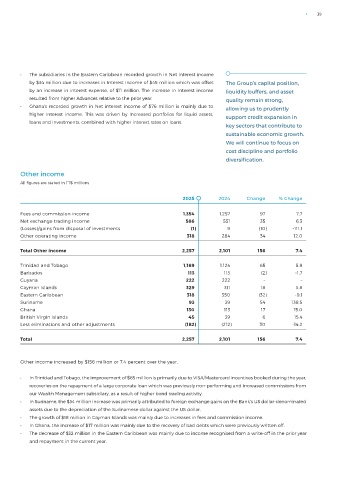
        Other income increased by $156 million or 7.4 percent over the year.


        •    In Trinidad and Tobago, the improvement of $65 million is primarily due to VISA/Mastercard incentives booked during the year,
           recoveries on the repayment of a large corporate loan which was previously non-performing and increased commissions from
           our Wealth Management subsidiary, as a result of higher bond trading activity.
        •    In Suriname, the $54 million increase was primarily attributed to foreign exchange gains on the Bank’s US dollar-denominated
           assets due to the depreciation of the Surinamese dollar against the US dollar.
        •    The growth of $18 million in Cayman Islands was mainly due to increases in fees and commission income.
        •    In Ghana, the increase of $17 million was mainly due to the recovery of bad debts which were previously written off.
        •    The decrease of $32 million in the Eastern Caribbean was mainly due to income recognised from a write-off in the prior year
           and repayment in the current year.

