


Page 97 - Handout Digital Electronics
P. 97
LECTURE 12 SEQUENTIAL LOGIC CIRCUITS


            12.1 Introduction
            A sequential logic circuit is a digital circuit whose output depends on the following:

               •  Present inputs
               •  Present State
               •  Previous inputs


               Sequential circuits have memory (storage) capabilities so they can somehow “remember” previous
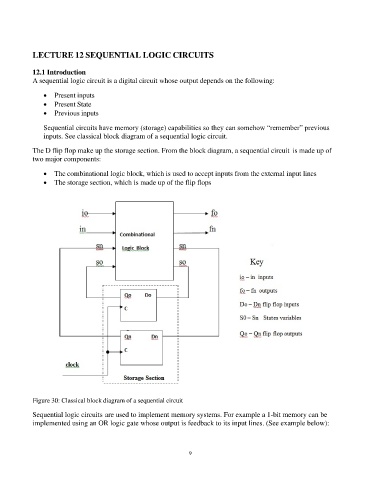
               inputs. See classical block diagram of a sequential logic circuit.

            The D flip flop make up the storage section. From the block diagram, a sequential circuit  is made up of
            two major components:

               •  The combinational logic block, which is used to accept inputs from the external input lines
               •  The storage section, which is made up of the flip flops


            Figure 30: Classical block diagram of a sequential circuit

            Sequential logic circuits are used to implement memory systems. For example a 1-bit memory can be
            implemented using an OR logic gate whose output is feedback to its input lines. (See example below):


                                                                97

