


Page 500 - Med Plaza and Cancer Center
P. 500
3/THEORY OF OPERATION


              3.3 Input Continuity                              3.5 Outputs

              The pressure switch inputs, J4 through J9, are also  Figure 9
              monitored for continuity.
                                                                Whenever an alarm condition is recorded by the
              If, for example, the switch gauge connection at J4 should  microprocessor, one of the 6 output ports will send a
              become disconnected, the voltage on pin 25 of U3 will be  Logic “1” signal to IC (Integrated Circuit) U1. IC-U1
              pulled to ground (Logic “0”) through R20. The     contains seven open collector Darlington drivers each
              microprocessor will see this as a fault condition and  capable of sinking 500 mA. Each driver energizes one of
              initiate the alarm state. Disconnections at the other inputs  six relays and LED bars. If more than one fault condition
              (J5-J9) are monitored in the same fashion.        is recorded by the microprocessor, additional signals are
                                                                passed to U1 which in turn energizes additional relays
              Note: Unused switch gauge connections require the use  and LED bars.
              of a shorting harness to maintain the current path and
              hold the respective U3 pin(s) at a Logic “1” level.  In addition to buffer U1 the Logic “1” signal is also sent to
                                                                the base of Q1. This normally off transistor turns on and
                                                                causes the (-) terminal of the audio alarm to go to ground
              3.4 Microcomputer                                 potential. Since +12 volts is on the (+) terminal at all
                                                                times, the alarm activates the instant the (-) terminal
              Figure 8                                          goes to ground potential.
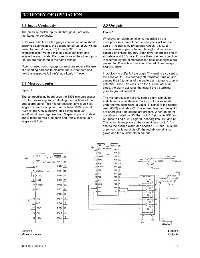
              The control/display board uses the 6805 microprocessor  The microprocessor not only sends alarm signals for
              (U3) for processing and controlling the functions of the  audible and visual alarm activation, but it also sends,
              area alarm panel. This microprocessor (,uP) is an 8-bit
                                                                under normal conditions, a Logic “1” signal to the normal
              single chip microcomputer that contains 1100 bytes of  lamp (DS3) and relay K1. The normal lamp and relay K1
              ROM (Read Only Memory). This device uses 20       are energized if no alarms are present. When an alarm
              input/output lines organized into 3 specific ports. Ports A  condition is noted by U3, the Logic “1” signal to DS3 and
              and B make up two 8-bit ports and Port C makes up a  K1 goes to Logic “0”. Logic “0” deenergizes DS3 and K1.
              single 4-bit Port.
                                                                This action takes place at the same time a Logic “1” is
                                                                sent to the audible alarm and specific LED bar. Thus, the
                                                                green normal lamp shuts off, the red abnormal lamp
                                                                glows and the audible alarm sounds.


              Figure 8                                                                                  Figure 9
              Microprocessor                                                                            Outputs


              0178-0135-000  Rev. A                                                                         3-2

